Routing Logic
Overview
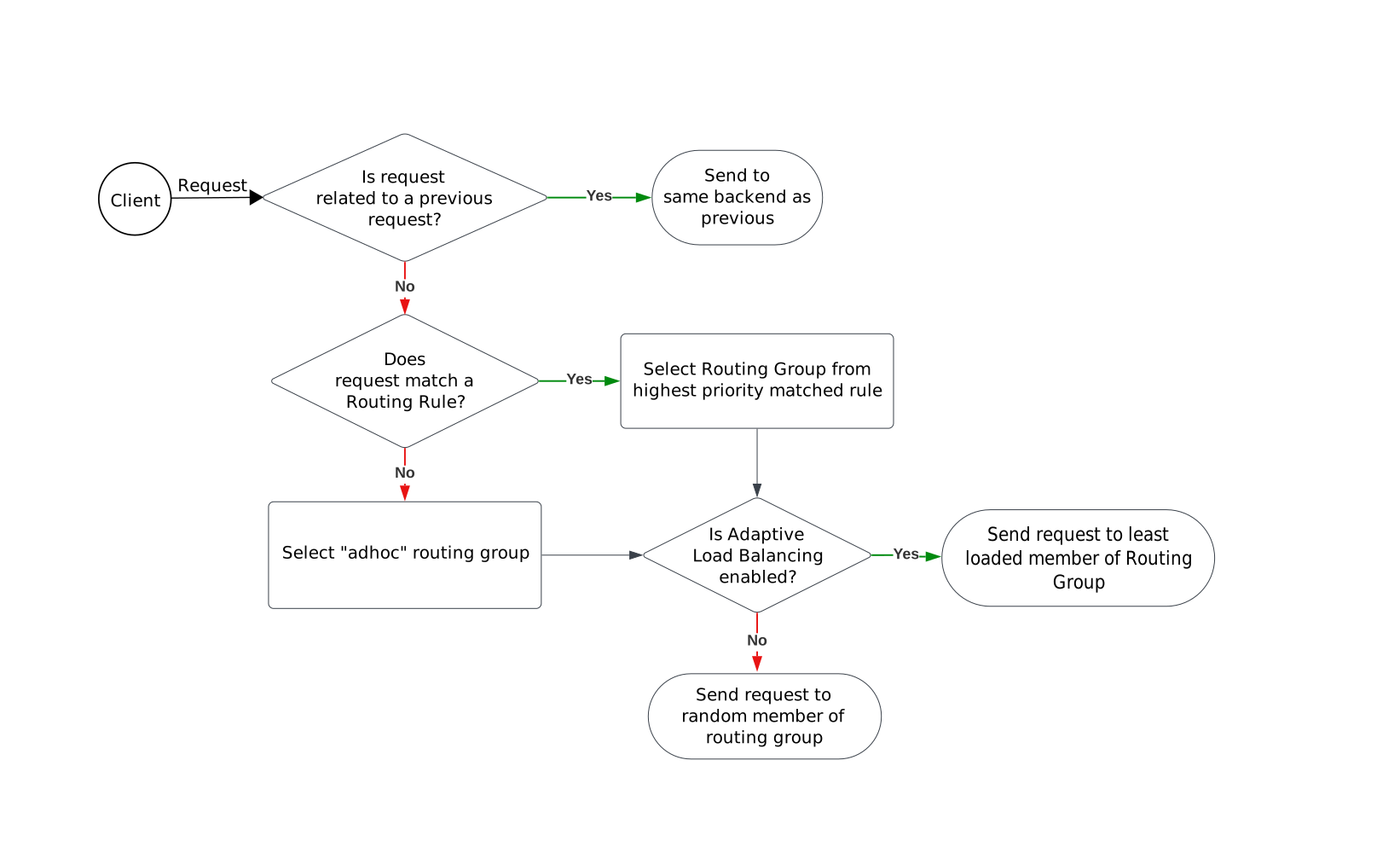
Trino Gateway checks incoming requests to see if they're related to previous ones it handled. If they are, then Trino Gateway sends them to the same Trino cluster that dealt with the earlier requests.
If it is a new request, the Trino Gateway refers to Routing rules to decide which group of clusters, called a 'Routing Group,' should handle it. It then picks a cluster from that Routing Group to handle the request using either an adaptive or round-robin strategy. Only clusters that are currently healthy are eligible — see Cluster configuration and health status for details on how health status is determined.
Sticky routing
A request related to an ongoing process, or to state maintained on a single Trino cluster, must be routed to that cluster for proper handling. Two mechanisms for identifying related requests are currently implemented. By default, only routing based on query identifier is enabled.
Routing based on query identifier (default)
When a query is initiated through the Trino Gateway, the query id will be
extracted from the response and mapped to the cluster that provided the
response. Any subsequent request containing that query id will be forwarded
to that cluster. For example, to retrieve query results, the Trino client
polls a URI of the form
v1/statement/executing/queryid/nonce/counter. The Trino Gateway will extract
the queryid from this URI.
Routing based on cookies
OAuth2 authentication requires that the same cluster is used for each step of
the handshake. When gatewayCookieConfiguration.enabled is set to true, a cookie
will be added to requests made to paths beginning with /oauth2 unless they already have
a cookie present, which is used to route further /oauth2/* requests to the correct cluster.
Cookies are not added to requests to v1/* and other Trino endpoints.
Trino Gateway signs its cookies to ensure that they are not tampered with. You
must set a cookieSigningSecret string in your configuration
cookieSigningSecret.
The Trino Gateway handles standard Trino OAuth2 handshakes with no additional configuration. If you are using a customized or commercial Trino distribution, then the paths used to define the OAuth handshake may be modified.
routingPaths: If the request URI starts with a path in this list, then
- If no cookie is present, add a routing cookie
- If a cookie is present, route the request to the cluster defined by that cookie
deletePaths: If the request URI starts with a path in this list,
return a response that instructs the client to delete the cookie.
Additionally, the lifetime property sets the duration for which a cookie remains in
effect after creation. Ensure that it is greater than
the time required to complete the handshake. Default lifetime is 10 minutes.
These properties are defined under the oauth2GatewayCookieConfiguration node:
oauth2GatewayCookieConfiguration:
  routingPaths:
    - "/oauth2"
    - "/custom/oauth2/callback"
    - "/alternative/oauth2/initiate"
  deletePaths:
    - "/custom/logout"
  lifetime: "5m"
Routing based on OAuth2 token-exchange pinning (opt-in)
Trino's OAuth2 token-exchange handshake for the CLI/driver spans two HTTP
clients that only share an internal identifier (authId, and its hash):
- the driver/CLI polls
GET /oauth2/token/{authId}until the login completes - the browser is redirected to
GET /oauth2/token/initiate/{authIdHash}, and then returns from the identity provider toGET /oauth2/callback(which carries theauthIdHashinside its signedstateparameter)
Only the Trino coordinator that issued the original 401 challenge holds the
in-memory state for that handshake. In a deployment with multiple
coordinators, Trino Gateway's normal routing may send the poll loop, the
initiate redirect, or the callback to a different coordinator than the one
that started the handshake, causing the login to stall. The cookie-based
routing above cannot solve this on its own: the CLI/driver poll loop does not
carry cookies.
When routing.oauth2RoutingEnabled is set to true, Trino Gateway records the
authId/authIdHash advertised in the 401 challenge together with the
coordinator that issued it, and pins every later request of that handshake —
the poll loop, the initiate redirect, and the callback — back to the same
coordinator:
Pins are stored in the gateway's database so they are visible across every
Trino Gateway instance, and are cleaned up automatically; see
dataStore.oauth2RoutingRetention (default 1h) to change how long a
pin is kept. If the pinned coordinator becomes unavailable before the
handshake completes, Trino Gateway drops the pin and asks the client to
re-authenticate, since the handshake cannot be resumed on another coordinator.
This feature is off by default.
Routing URLs
Each Trino cluster configured with the Trino Gateway includes both a proxyTo
URL and an externalURL. The proxyTo URL is used internally by the Trino
Gateway to route requests based on routing rules and query identifiers, whereas
the externalURL serves as a UI-accessible or publicly reachable address for
the Trino cluster, and is commonly used to access Trino web UI
For example, in a Kubernetes environment, the proxyTo URL might be
trino-backend-service.trino-namespace.svc.cluster.local:8083 for communication
between the Trino Gateway and Trino clusters, and the external URL for the same
backend cluster might be trino.domain.com.